
A better way to slot a tune-o-matic bridge, perhaps…
On my teles I practically never break strings. I’ve had them last a year, way past being worn out. On a guitar with a tune-o-matic bridge, I’m lucky to make it through a gig without breaking my high E at the saddle. I know a lot of people don’t have this problem. Maybe they don’t do the big Albert King bends I like to do? Maybe they have a softer touch? I don’t know. I’ve tried deburring the saddle with no real improvement. I’ve used string saver saddles, which help some but affect the tone in a way I don’t like and still barely get me through a gig without breaking a string. I could put a roller bridge on, but I could write a whole other article on how that can affect tone. Also, I want to keep the bridge looking stock if I can. I’m pretty sure that the secret is how the saddles on my tele are shaped where the string takes off. So, why not slot my tuneomatic saddles similar to the Gotoh In-Tune saddles on my favorite tele?
Yesterday afternoon I sat down and modeled it in Fusion 360. The image below is an ABR-1 saddle and two 10 gauge strings to scale. One string is bent halfway across the fretboard at about the 14th fret, similar to a big bend, and the other is unbent. The slot is 1/16″ diameter and it’s center curves at a 1/8″ radius like a groove arround a tele barrel saddle and the takeoff point of the string is 1/32″ back from the face of the saddle.
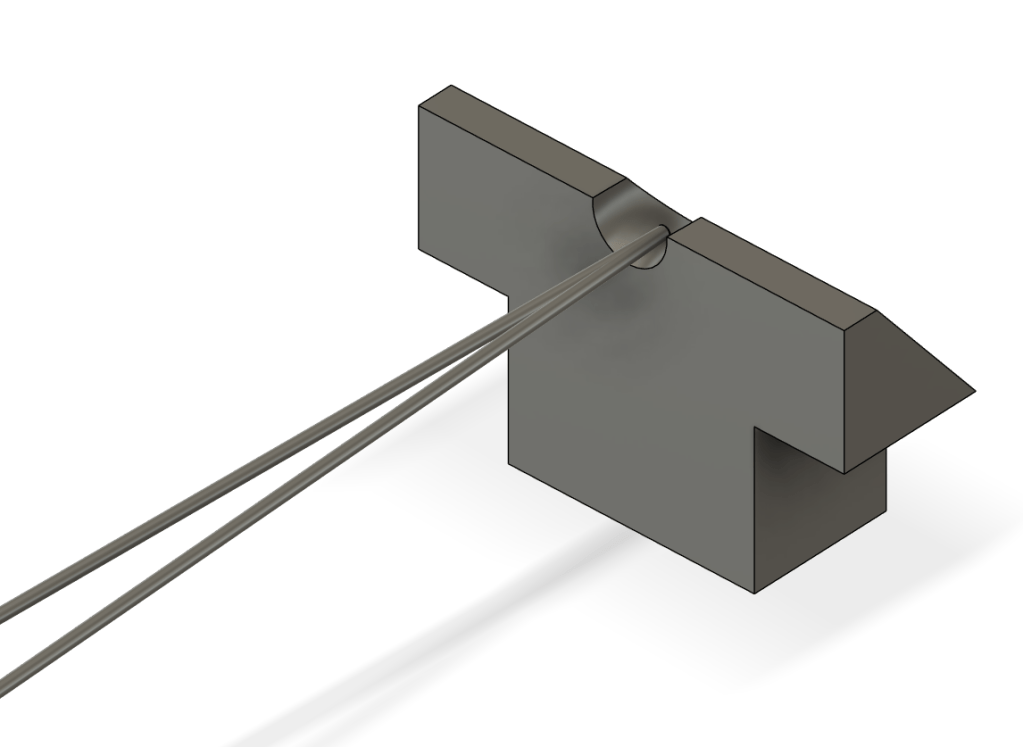
THE POINT: This allows the string to bend around a gentle curve when bent versus a typical slot that has the takeoff point at the face of the saddle. This is similar to wrapping a piece of paper around a pencil versus folding it over a square corner and creasing it. The paper tears more easily at the crease, and the string eventually breaks at that stress point. It’s even worse if the string gets nicked like when there is a burr. I’m sure this bending around a curve at the takeoff point instead of against a square corner is the secret to why my strings last longer on my teles.
I was imagining a fixture to precisely slot the saddle like this when I realized I could do something close enough by hand using a .045 bass nut slot file. So that’s what I did, widening the existing slots and moving the takeoff point slightly back into the saddle by angling the file downward at the front of the slot to curve it. I then smoothed the slots out using p600 grit paper. It wouldn’t hurt to follow that with p1200 grit as well to further smooth it. I also cut them shallower than the picture, only going to the depth of the existing slot. Then I adjusted intonation and I’m in business.
We’ll see how it works out! I’m pretty confident that this will do the trick for me. If it doesn’t, the next step is to make a fixture to precisely slot the saddles like my model in Fusion 360.
I hope this helps!

 RTH Guitars